











March 3, 2026
MOQ, Packaging, and Compliance: How to Prepare for Big Box Distribution
Garrett Browne
• 3 minute read
Landing a national retail opportunity is a growth milestone. It signals demand, brand traction and expanded reach. It also introduces a different level of operational risk.
Once a product moves into big box retail, launch dates are tied to shelf resets. Purchase orders are linked to promotional calendars. Packaging specifications are enforced at distribution centers. Compliance documentation becomes subject to review. Chargebacks are automated.
At that point, the question is no longer whether you can produce more. It’s whether your systems can withstand national distribution without margin erosion or disruption.
Retail success depends less on demand and more on preparation.
The First Mistake: Assuming Scale Is Linear
One of the most common misconceptions companies have when preparing for big box distribution is assuming that scaling up is simply a matter of doing more of the same.
If a formulation blends smoothly and packaging runs efficiently at regional volume, it can feel logical to assume those same systems will perform the same way nationally.
But, in reality, packaging run sizes, material availability and compliance requirements change significantly at retail scale. Without planning for those differences early, costs and timelines can quickly move out of alignment.
Retail expansion involves significant structural change. Preparing properly means validating each operational layer before committing to retail distribution.
1. Validate Production Economics Before You Commit
The first evaluation should focus on production efficiency.
Retail purchase orders rarely align perfectly with the most efficient manufacturing batch size. Without planning, that mismatch can increase labor, inflate changeover time and strain inventory management.
As companies move into national retail, MOQs often increase not arbitrarily but structurally. Packaging components must be purchased in larger quantities. Labeling becomes more complex. Line changeovers require longer uninterrupted runs to maintain efficiency and consistency.
Understanding where those minimums originate allows production volumes to be planned around retailer expectations instead of reacting to them after the fact.
Leadership teams should be asking:
- Does the retailer’s projected volume align with optimal batch sizing?
- Are SKUs being modeled individually or across coordinated production campaigns?
- How will extended run lengths affect scheduling across facilities?
Manufacturers preparing for retail often revisit their approach to contract chemical manufacturing turnkey solutions to ensure blending, packaging and distribution strategies are aligned before retail commitments are finalized.
When production modeling happens early, MOQ becomes a strategic lever instead of a reactive constraint.
2. Stress-Test Packaging for National Distribution
After validating production efficiency, the next step is packaging resilience.
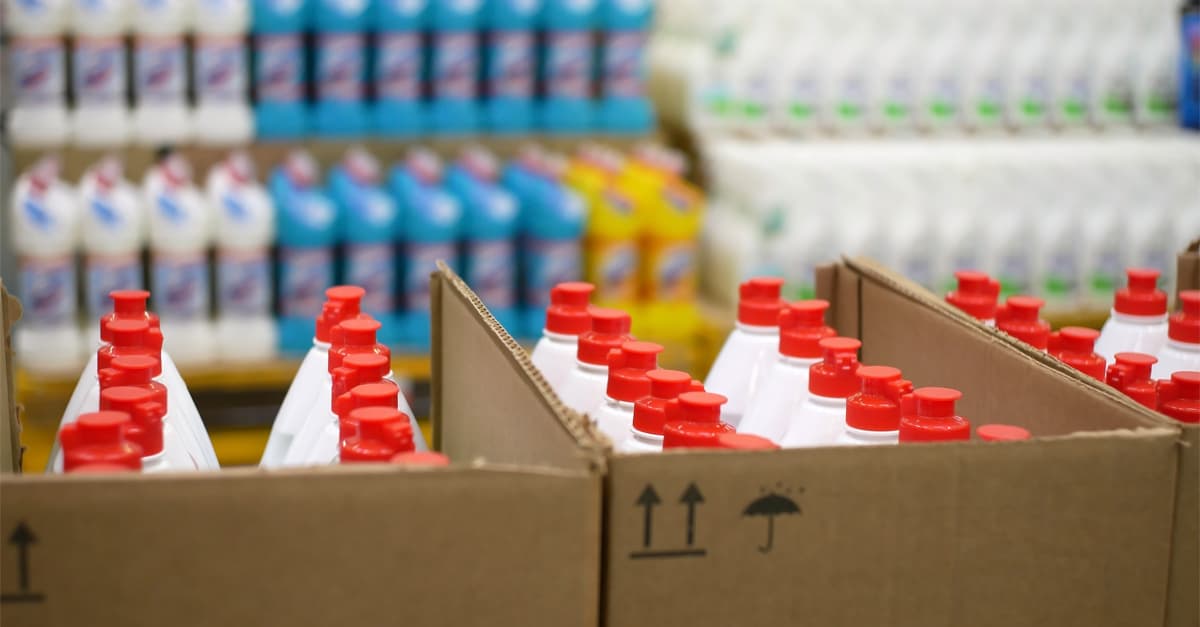
Retail-ready packaging must perform across pallet stacking, automated case handling, distribution center transfers and long-haul freight.
When products reach big box shelves, durability, consistency and presentation shift from secondary considerations to primary risk factors.
Packaging that performs well in smaller channels may not withstand national distribution or automated handling environments. Closure performance, label placement and case configuration all come under closer scrutiny.
Container Durability
Containers must tolerate compression, vibration and stacking at scale. This is why many teams reassess their chemical storage bottle selection before expanding distribution, ensuring container specifications align with broader logistical demands.
Closure and Label Consistency
Torque consistency, seal integrity and trigger performance must remain stable across longer runs. Retailers expect strict adherence to barcode placement, case labeling standards, lot traceability and regulatory language. Errors in packaging execution often trigger penalties faster than formulation issues.
Reliable packaging capabilities are critical to maintaining repeatable performance across higher-volume retail runs.
Retail packaging is not just about presentation. It is about system reliability.
3. Audit Compliance Before Retail Does
National distribution increases visibility, and visibility increases scrutiny.
Retailers expect strict adherence to regulatory requirements, accurate labeling, lot traceability and consistent quality documentation. Gaps that may have been manageable at a smaller scale can become significant operational risks once volumes expand.
Compliance validation should happen before retail onboarding.
Key areas to confirm include:
- EPA registration and sub-registration alignment
- Documented lot traceability systems
- Standardized batch records
- Certification verification
- Defined quality control checkpoints
For antimicrobial and disinfectant products, confirming EPA sub-registration for antimicrobials prior to scaling distribution is essential, as documentation and labeling requirements expand with exposure.
Compliance should function as an operational system, not a launch milestone.
The Silent Risk: Calendar Compression
Even when production, packaging and compliance are validated, timeline coordination becomes the final pressure point.
Retailers operate on fixed promotional calendars and shelf resets. Once dates are established, flexibility narrows.
Launch risk typically stems from misalignment between:
- Raw material procurement
- Packaging component lead times
- Blending schedules
- Quality release timelines
- Freight booking
A delay in one area can cascade into missed delivery windows.
Reducing that risk requires coordinating production volumes, packaging requirements and compliance expectations well before launch. Established quality systems and multi-site manufacturing infrastructure support consistent execution under tight retail deadlines.
Calendar compression is rarely a blending issue alone. It is a coordination issue.
Retail Readiness Self-Assessment
Before finalizing a big box agreement, leadership teams should confidently answer yes to the following:
- Have we modeled MOQ against true production efficiency?
- Have we validated packaging durability under national distribution conditions?
- Is our compliance documentation audit-ready today?
- Are packaging component lead times aligned with launch windows?
- Is freight strategy built into our cost structure?
If uncertainty exists in any of these areas, preparation should begin before the first purchase order is issued.
Preparing for Big Box Retail With Confidence
Reducing retail risk requires aligning production volumes, packaging requirements and compliance expectations before launch.
Royal Chemical supports that preparation by coordinating blending, packaging and distribution through established quality controls across five U.S. facilities. This structured approach helps clients meet retailer standards consistently and avoid last-minute surprises as volume increases.
If your team is evaluating national distribution, talk to an expert or request a quote to begin preparing for retail-ready scale.
Talk to an Expert
Streamline Your Chemical Manufacturing Process
Royal Chemical’s expertise in blending, packaging and shipping can save you time, reduce costs and deliver consistent results.